October 07, 2026


Ask a reader to picture a pipe smoker and they will almost certainly draw a deerstalker. For more than a century, British fiction has used the pipe as shorthand for a particular kind of character: patient, self-contained, faintly indifferent to the clock. That shorthand did not happen by accident. Writers reached for the pipe whenever they needed to show a mind at work or a man at home, and the result is a remarkably consistent portrait of leisure, ritual and interior life.
Arthur Conan Doyle did more than any other writer to fix the pipe in the British imagination. Holmes is not simply a man who smokes; his smoking is a unit of measurement. When he calls a case a three-pipe problem, he is telling Watson how long he intends to sit in silence. The pipe marks time — a private clock that runs on thought rather than minutes.
Doyle uses that clock for characterisation. Holmes keeps his tobacco in the toe of a Persian slipper, owns pipes of several shapes, and pins his unanswered letters to the mantelpiece with a jack-knife. Watson, by contrast, is tidy, decent and slightly baffled. The pipe is never mere decoration. It tells you that Holmes's brilliance is not effortless — it is the product of long, unglamorous sitting, and plenty of tobacco burned while nothing much appears to be happening.
Where Doyle used the pipe to show how a mind works, J.R.R. Tolkien used it to show what a life is for. Hobbits smoke pipe-weed grown in the Southfarthing, with Longbottom Leaf the best known, and the habit is bound up with everything they value: gardens, ale, mushrooms, an unhurried evening, a well-stuffed armchair.
Gandalf blows smoke rings in the opening pages of The Hobbit, and the resulting contest with Thorin is one of the first things that shows us how the Shire works. Smoke rings are a game, not a vice — a way of being sociable without saying very much. Tolkien even gives the habit a mock-scholarly history in the prologue to The Lord of the Rings, where the hobbits claim to have invented pipe-weed and Meriadoc Brandybuck is credited with a learned treatise on the subject. In a story about a long and grim journey, the pipe is the taste of home.
Victorian and Edwardian fiction is full of pipes, but rarely as drama. They belong to the margins: the chair by the fire, the window after dinner, the smoking room. Novelists of the period used tobacco as a social marker — cigars for the flashy, cigarettes for the young and fashionable, a briar or a clay for the steady man who stayed put.
What the fiction notices is the ritual: filling, tamping, lighting, and the small pause before speech. A pipe gives a character something to do with their hands and a legitimate reason for silence. Given how fond nineteenth-century novelists were of long stretches of dialogue, that was useful. It is no coincidence that the most quoted pipe smoker in English fiction is also the one who most often asks to be left alone.
Props simplify, and the pipe is no exception. Even so, some of the portrayals get the method right. Fictional smokers pack a bowl, test the draw before lighting, and think nothing of letting a pipe go out and returning to it later. Real pipe smoking is exactly that: a series of interruptions.
What the fiction leaves out is the maintenance. Cleaning and resting pipes, the sour taste of a neglected bowl, the bite of tobacco smoked too hot — none of that makes it onto the page. Literary pipes are never fussy. Anyone who owns one knows better.
If the fiction has tempted you towards a pipe, treat it as a ritual rather than a habit. A few things make the difference between a pleasant half hour and a scorched tongue:
One thing no novel will tell you: a pipe is not a safe alternative to cigarettes. If you smoke, or are thinking of starting, your GP or a local stop-smoking service is the right place for advice, and nothing on a printed page changes that.
Read the pipe scenes anyway. They are one of the clearest windows British fiction offers onto its own idea of a good life: unhurried, private, and lit by something small and steady.
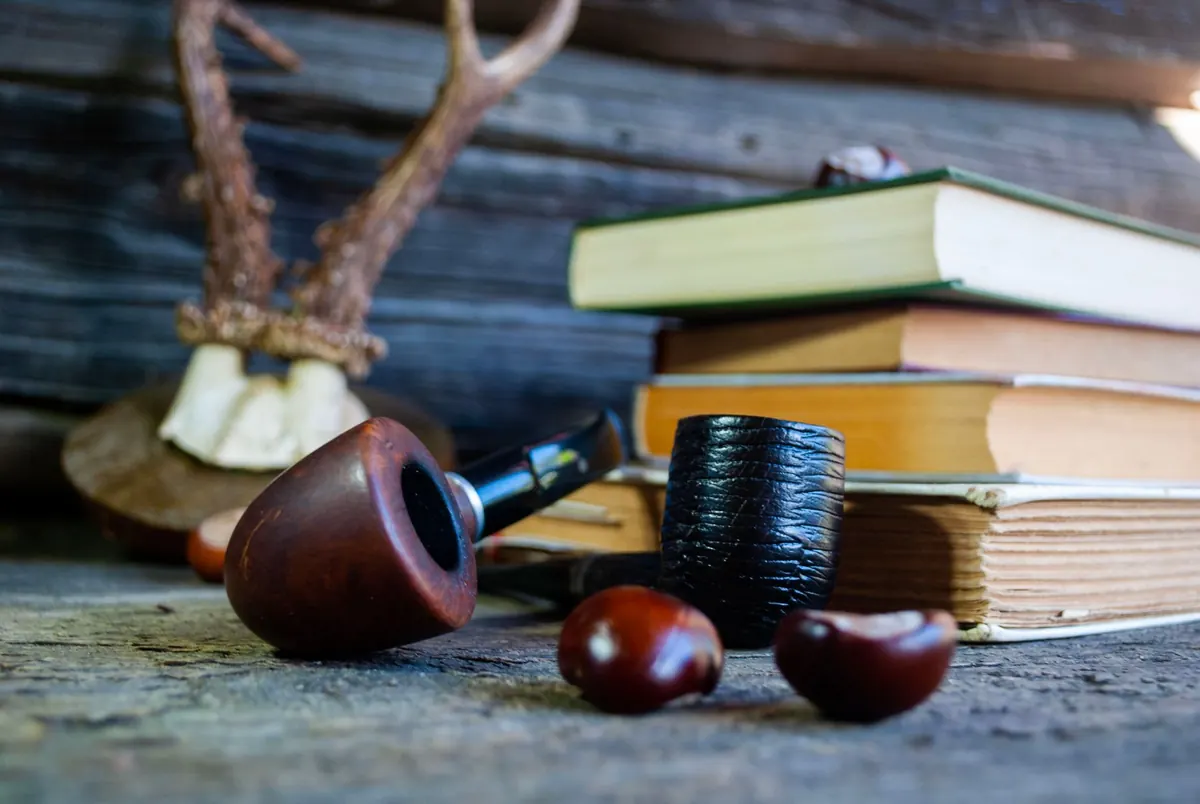
Photo: Андрей Рабцев / Pexels
The magazine for briar pipe enthusiasts.
Copyright © 2026 Briar Mag. All rights reserved. Briar Mag.